
The Hair
Structure of the hair
Below the surface of the skin is the hair root, which is enclosed within a hair follicle.
At the base of the hair follicle is the dermal papilla. The dermal papilla is supplied with nourishment from the bloodstream to produce new hair. The dermal papilla structure is vital to hair growth because it contains receptors for male hormones and androgens.
Androgens regulate hair growth. In scalp hair, the androgens may cause the hair follicle to become progressively smaller, causing the hair to become finer in individuals who are genetically predisposed to this type of hair loss.
Hair Growth Cycle
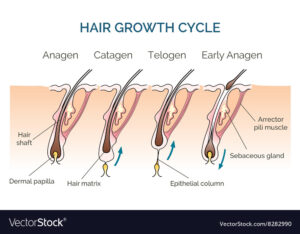
Hair follicles grow in repeated cycles. One cycle consists of three phases:
| Anagen | Growth Phase |
| Catagen | Transitional Phase |
| Telogen | Resting Phase |
Each hair passes through the phases independent of neighbouring hairs.
Anagen Phase
Approximately 85% of all hairs are in the growing phase at any time. This growth phase can vary from 2 years to six years. Hair will grow approximately 10cm per year, and any individual hair is unlikely to grow more than one meter long.
In the anagen stage, the hair receives nourishment from the blood supply from the dermal papilla. This enables the cells to reproduce. Cells move upwards to form the different structures of the hair shaft. Melanin is also produced to form the hair colour.
Catagen Phase
This is the transitional phase that follows the growth phase. The catagen phase lasts around one to two weeks. During the catagen phase, the hair follicle shrinks to about 1/6 of the normal length. The lower part is destroyed, and the dermal papilla breaks away to rest below.
This is the inactive or resting stage of hair growth. In this stage, the dermal papilla breaks away to make the lower end of the hair become loose from the base of the follicle. The hair is still being fed from the follicle wall and is sometimes known as club-ended hair. The hair starts to become drier and continues to move up to just below the sebaceous gland. At this stage, it can be easily brushed out.
Telogen Phase
This resting phase follows the catagen phase and lasts around five to six weeks. During this time, the hair does not grow but stays attached to the follicle whilst the dermal papilla stays in a resting phase below. Around 10-15% of hairs are in this phase at any time.
The hair follicle re-enters the anagen phase. The dermal papilla and the base of the follicle join together again, and a new hair begins to form. If the old hair has not yet been shed, the new hair pushes the old one out, and the growth cycle starts over again.
Hair Types
Vellus hair is the fine, non-pigmented hair that covers the body of children and adults. It does not usually grow longer than 2cms in length. Vellus hair is usually straight, regardless of ethnic origin, due to the fact that the follicles are not deep. The growth of vellus hair is not affected by hormones.
Terminal hair is the thick pigmented hair found on the scalp, beard, underarms, and pubic area. The growth of terminal hair is influenced by hormones.
Terminal hair is generally more abundant on males than females. However, variations exist within populations, with some women appearing hairier than some males.
These hair types can be straight, curly or wavy depending on ethnic origin, hereditary factors and chemical hair treatment such as perms.
European hair would appear to be oval in shape and would tend to be wavy. Asian hair would appear to be round in shape and tend to be straight. Afro-Caribbean hair would appear to be flattened and tend to be very curly.
In some cases, excess hair growth, called hirsutism (pronounced: hur-suh-tih- zum), maybe the result of certain medical conditions. In girls, polycystic ovary syndrome and other hormonal disorders can cause dark, coarse hair to grow on the face, especially the upper lip, and on the arms, chest, and legs. Some medications, like anabolic steroids, can also cause hirsutism.
Superfluous hair is coarse unwanted hair, also termed hypertrichosis. Superfluous hair is considered not only a physical burden but can become a psychological one, too if not treated. The modern woman is keenly aware of the importance of being well-groomed; her happiness, poise, even her success or failure in life very much depend upon the face she presents to the world.
The reluctance and timidity of women to discuss this condition would vanish if they realised superfluous hair is not something to be ashamed of, but a simple problem requiring remedial treatment.
It is estimated that 80% of the women in Britain have some superfluous hair growth. Generally considered a “cosmetic” issue, hair growth can cause real or perceived problems with social acceptance for many people, both male and female. Many cultures have a perceived ideal amount of hair growth. Changes in hair growth patterns are sometimes a symptom of hormonal imbalances. Managing or removing unwanted hair can go beyond being a simple “cosmetic” problem.
Changes in Growth Patterns
The hair growth pattern can change due to several factors:
Illness – Illness has a strong effect on hair growth, usually making it lank and lifeless. It can also cause hair loss, or growth of unwanted hair.
Medication – Drugs can affect the growth pattern; hair may become coarse and thick. Follicles can often be weakened, causing hair to fall out. In some cases, this can be temporary.
Hormones – Different changes of life can affect hair growth, e.g. women going through the menopause may find they develop whiskers of coarse hair on their face. Endometriosis or Polycystic Ovaries can cause male pattern hair growth in women.
Emotion – Sudden shock, an accident, or stress can all lead to hair loss. This is called alopecia (patches of hair loss). Causes of Hair Growth
Excess hair growth can be either normal or abnormal and may be the result of a number of causes.
- Topical – Hair growth caused by irritation of the skin caused by friction which results in an increased blood supply. The hair follicles receive more nutrients and thus grow longer and thicker hair. The removal of vellus hair by plucking can also cause the hair follicle to become deeper, causing more blood supply and the change in structure from vellus to terminal. For example, sunburn can cause excess hair growth, as can moles, scars and birthmarks.
- Congenital – this type of hair growth is inherited. The person can be born with it or develop it later in life.
- Systemic – this includes normal hair growth caused by hormones from puberty, pregnancy and menopause, as well as abnormal hair growth caused by hormonal imbalances from diseases, surgery, tumours, medicine or stress.
Malfunctions of the endocrine system and the effects on hair growth
Abnormal hair growth is often caused by an abnormal change in the endocrine system, which causes a hormonal imbalance. This can be due to illness, tumours, medication or dietary disorders.
Virilization
This is when the female body becomes more masculine, and results develop heavy facial hair and excess body hair growth in the male pattern of growth. A hormone imbalance that can be due to a tumour on the adrenal cortex or a tumour on the ovaries can influence the hypersecretion of androgens and the reduction in the release of oestrogen. This causes abnormal systematic hair growth.
Virilization is also accompanied by loss of menstruation, deepening of the voice, loss of scalp hair, development of acne, and the breast tissue reduces, and the body thickens.
Polycystic Ovary Syndrome
A variety of symptoms can be seen with this condition, including heavy or irregular periods, excessive facial and body hair growth and infertility. It is caused by cysts or growths on the ovaries that develop due to non-completion of the ovulation process.
Cushing Syndrome
This is caused by tumours on the adrenal cortex where it causes the gland to produce too much cortisol. There is an associated overproduction of androgens, and as a result, a heavy male pattern of hair growth can be seen. Other symptoms may include a thickening of the trunk, round face, dowagers hump and thin legs and arms.
Anorexia Nervosa
Clients suffering from this eating disorder become very thin and undernourished. It is, therefore, quite common to see excessive hair growth all over the face and body. This is caused by a shutdown in the ovaries that reduces the amount of oestrogen produced and stimulating the androgens. Females who exercise or undertake athletic training may also be affected by the same symptoms.
Medication
Some prescribed drugs such as androgens or anabolic steroids have a secondary effect causing excess hair growth.